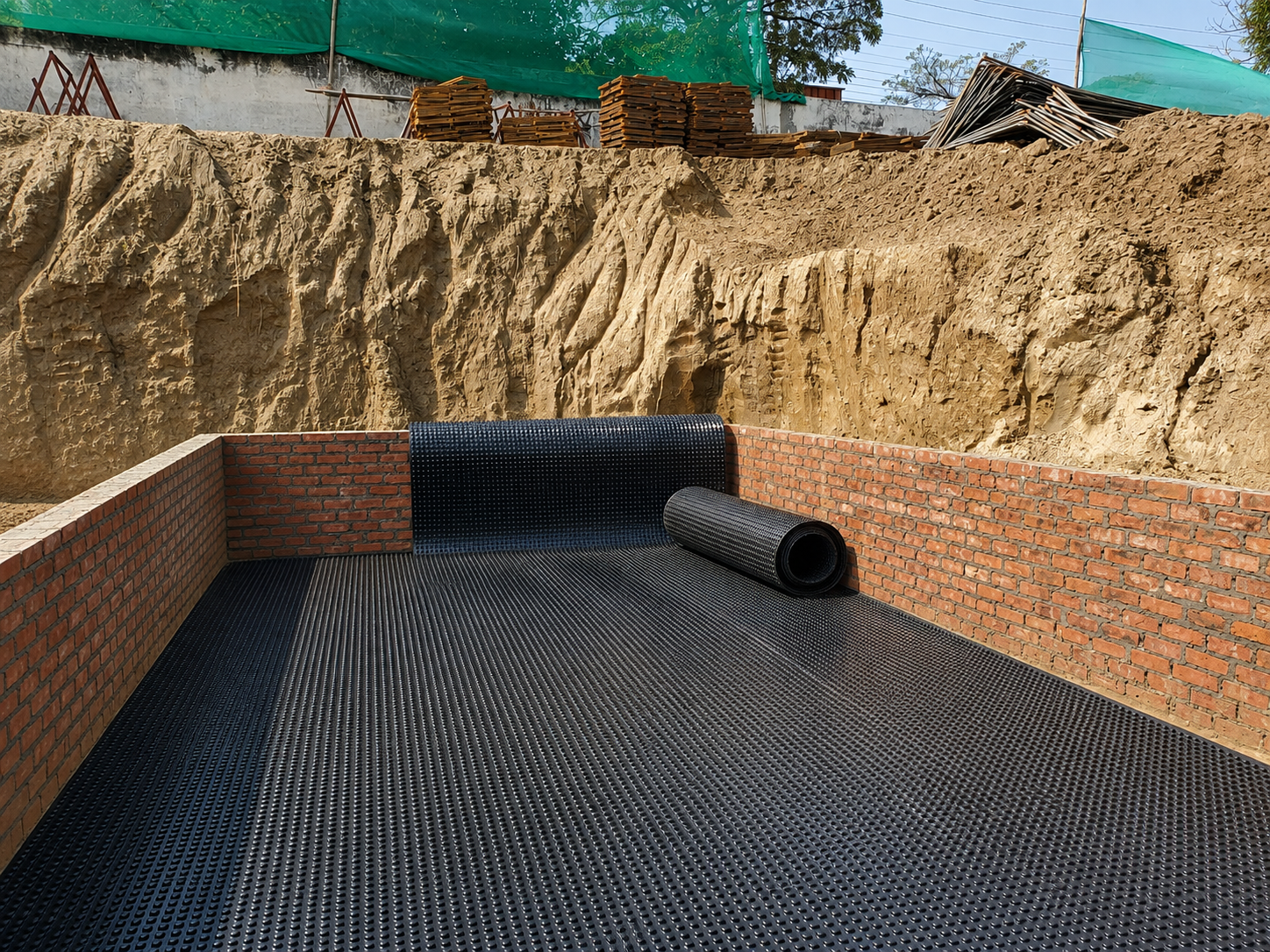
Anchor Grip membrane laid across a basement raft pit ahead of concreting — the square-grid locking texture is visible underfoot.
If you've ever seen a basement leak appear nowhere near where the actual damage happened, you've witnessed the single biggest reason waterproofing fails below ground. It isn't bad luck. It's a structural flaw built into how most membranes are installed — and once you understand it, the fix becomes obvious.
Basements are the most punishing part of any building to waterproof. They sit below the water table, under constant hydrostatic pressure, surrounded by soil that's often chemically aggressive. And unlike a terrace or a bathroom, you don't get a second chance once the raft is poured — every mistake gets buried under tonnes of concrete and stays hidden until the day water finds its way in.
So why do so many basements still leak, even when a "waterproofing membrane" was installed? The answer lies in one overlooked detail: whether that membrane was actually bonded to the concrete, or just laid loosely beneath it.
For decades, Indian construction has waterproofed basements using one of two methods — and both share the same hidden weakness.
This legacy method builds a rigid "box" of stone slabs and cement mortar around the raft. It's been used for generations, but it has a fatal flaw: stone and mortar are brittle. They cannot move with the structure. The moment there's any structural settlement — and almost every building settles slightly after construction — the rigid jointing cracks, and once it cracks, there's no way to repair it locally. The whole system has already failed.
Modern sites moved to synthetic sheet membranes because they're flexible and faster to lay. But here's the part that rarely gets explained to the people paying for it: a loose-laid sheet is never actually attached to the concrete. It just sits underneath, like a tablecloth.
This is where the real damage happens. If the sheet gets punctured during steel-fixing or while concrete is being poured — and on a real construction site, that happens more often than anyone likes to admit — there is now a continuous, unbonded air gap between the membrane and the raft. Groundwater that finds that one puncture doesn't stay put. It travels laterally, sideways, underneath the entire sheet, for metres in every direction.
A single puncture in one corner of the basement can surface as a wet patch fifty metres away. By the time anyone notices the leak, there's no way to know where the actual damage is — which makes targeted repair almost impossible.
This phenomenon even has a name in the waterproofing industry: lateral water migration. It's the reason so many "fully waterproofed" basements still develop leaks years later, and why repair often means re-excavating and redoing the entire system rather than fixing one small spot.
Farshi boxing fails because it's too rigid to move with the structure. Loose-laid sheets fail because they're never actually attached to it. Both methods share the same root cause: there is a physical gap between the waterproofing layer and the concrete it's meant to protect. Without a bond, water always finds the path of least resistance.
Modern below-grade waterproofing has moved toward what the industry calls fully bonded or pre-applied membrane systems — and it's the same engineering logic used in premium global systems for basements, tunnels and below-grade structures. Instead of laying a sheet and hoping it stays put, the membrane is designed to physically fuse with the concrete during casting, so the two become one continuous, monolithic barrier.
This is the principle behind Anchor Grip, Weatherblazer's composite plastic waterproofing membrane built specifically for basement rafts, retaining walls, lift pits, and underground water tanks.
| Parameter | Farshi / Box Type | Standard HDPE / PVC (Loose-Laid) | Anchor Grip |
|---|---|---|---|
| Water migration resistance | Poor — cracks easily under settlement | Very poor — water tracks freely beneath sheet | Excellent — blocked by locking grid |
| Installation speed | Very slow, labour-intensive | Moderate | Fast — saves time and labour |
| Settlement accommodation | None — highly brittle | Good | Excellent — >700% elongation |
| Lifecycle cost | High, due to repeated repairs | Moderate to high | Low — reduces overall cost by ~50% |
A specification you can stand behind with a written warranty, instead of one that turns into a callback two monsoons later.
Predictable execution timelines with semi-skilled crews — no specialised equipment, no exotic curing windows.
A membrane with enough elongation to accommodate settlement without compromising the waterproofing envelope.
A dry basement backed by an absolute written warranty — and roughly half the long-term cost of fixing a failed system later.
It's the process of installing a water-resistant barrier beneath and around the raft — the thick concrete slab foundation — before it's cast. Because the raft typically sits below the water table, it needs a membrane built to withstand constant hydrostatic pressure and chemically aggressive groundwater, not just occasional dampness.
Almost always because the membrane was loose-laid instead of bonded. Without a mechanical or chemical bond to the concrete, a single puncture lets water travel sideways underneath the entire sheet — so a leak can surface metres from the actual point of failure, making it nearly impossible to trace and repair.
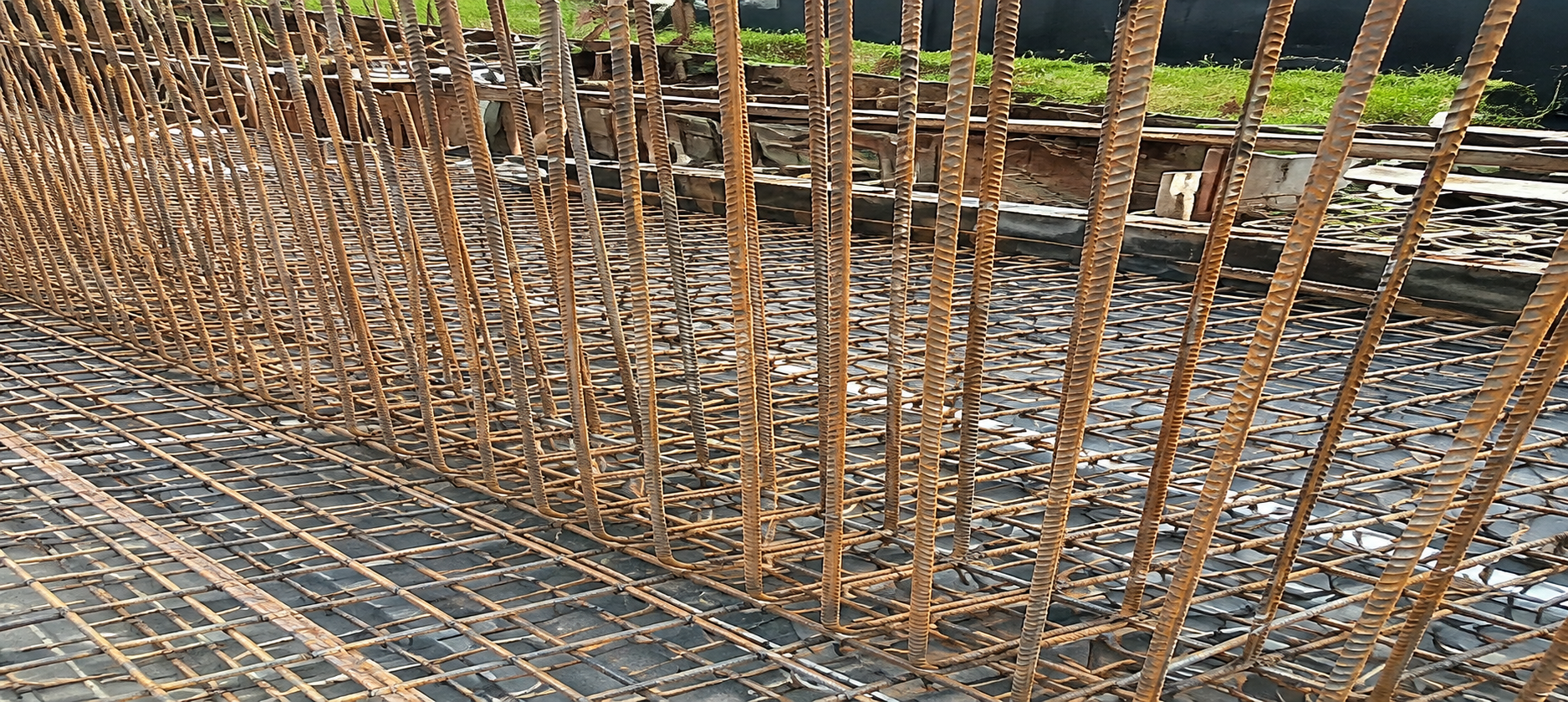
Anchor Grip's surface carries a grid of closely spaced, square-shaped locking extensions. When concrete is poured over it, those extensions physically key into the curing slab, fusing the membrane to the structure. That stops lateral water migration at the source — there's no continuous gap left for water to travel through, even if the membrane is locally damaged.
Yes, for any structure with a basement, lift pit, or underground tank. Even sites that look dry during construction can face a rising water table during monsoon. And rectifying a waterproofing failure after the building is complete costs far more than getting it right at the raft stage — by then, you're talking about re-excavation, not a simple patch.
A fully bonded composite membrane like Anchor Grip, installed with correct jointing and corner detailing, is designed to last the lifetime of the structure — because it becomes mechanically locked into the concrete itself, not laid as a separate, wear-prone layer that needs periodic replacement.
If your basement, lift pit, or underground tank is at the design or pre-pour stage, this is the one decision that's nearly impossible to fix later. Talk to our team before the raft goes in.
